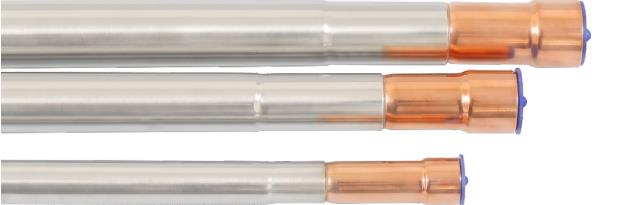
A copper-steel connecting tube is a stainless steel tube with pre-fabricated copper ends, designed to replace copper piping while keeping the on-site connection familiar: your installer brazes copper-to-copper at the tube ends.
This is not a plain copper pipe, a flexible hose or a DIY repair part. It is a factory-made copper to stainless steel transition pipe for project supply, used where engineers need the corrosion resistance of stainless steel but still need to connect into existing copper interfaces.
Quick Fit Guide
For engineers
- Use stainless steel for the main run where corrosion resistance matters.
- Keep the field joint copper-to-copper instead of welding stainless on site.
- Confirm coolant, refrigerant, pressure and joint details before production.
For purchasing teams
- Reduce exposure to copper price volatility in long pipe runs.
- Buy a pre-fabricated transition tube instead of managing separate adapters.
- Request common sizes or custom dimensions from drawings.
For installers
- One flared end and one straight end help fit existing copper systems.
- The critical stainless-to-copper joint is made at the factory.
- Optional insulation sleeves help with condensation control.
Why Replace Copper Piping Now?
Copper has long been the default for cooling and refrigerant lines, but two pressures are pushing engineers and buyers toward alternatives.
Rising Copper Cost and Price Volatility
Copper prices have moved sharply and unpredictably in recent years. That copper price volatility turns into budget uncertainty on every project. Building the main run from stainless steel reduces how much of your bill of materials is exposed to the copper market, while keeping copper only where it is actually needed—at the joints.
Corrosion and Leaks in Glycol and Mixed-Metal Systems
In systems that circulate glycol-based coolant, copper can corrode over time, and corrosion eventually means leaks, lost efficiency and downtime. In a mixed-metal system, copper in contact with other metals can also drive galvanic corrosion at the interface. Stainless steel holds up far more predictably against these coolants, which is why many cooling designs now specify stainless steel to replace copper—and why the next question becomes how to connect it.
Specifications and Sizes
Before reviewing the joining method, most buyers need to confirm whether the tube can match their project size. Common copper-steel tube sizes are listed below in stainless grades S30403, S30408 and SUS316. Sizes shown are typical; custom sizes are available to specification.
| Common Copper-Steel Connecting Tube Sizes (unit: mm) | ||||
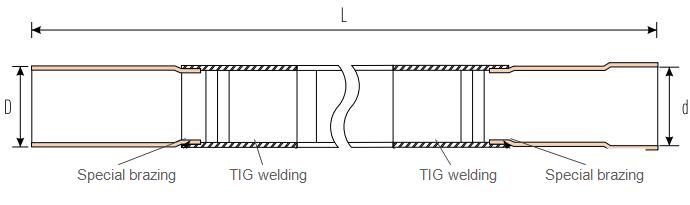
| Tube OD (D) | Flared ID (d) | Length (L) | Stainless wall thickness | Insulation sleeve |
| 15.88 | 16.04 | 3000 / 2000 | 1.0 | 20 / 30 |
| 19.05 | 19.21 | 3000 / 2000 | 1.0 | 20 / 30 |
| 22.2 | 22.36 | 3000 / 2000 | 1.0 | 20 / 30 |
| 25.4 | 25.56 | 3000 / 2000 | 1.0 | 20 / 30 |
| 28.6 | 28.76 | 3000 / 2000 | 1.0 | 20 / 30 |
| 31.8 | 31.96 | 3000 / 2000 | 1.2 | 20 / 30 |
| 34.9 | 35.06 | 3000 / 2000 | 1.2 | 20 / 30 |
| 38.1 | 38.26 | 3000 / 2000 | 1.2 | 20 / 30 |
| 41.3 | 41.46 | 3000 / 2000 | 1.5 | 20 / 30 |
| 44.5 | 44.66 | 3000 / 2000 | 1.5 | 20 / 30 |
| 50.8 | 50.96 | 3000 / 2000 | 1.5 | 20 / 30 |
| 54.1 | 54.26 | 3000 / 2000 | 1.5 | 20 / 30 |
| General Parameters | |
| Stainless tube material | S30403, S30408, SUS316 |
| Stainless wall thickness | 1.0–2.5 mm |
| Copper end wall thickness | 1.5–3.0 mm |
| Diameter coverage | approx. Ø16–159 mm |
| Standard length | 2000 mm / 3000 mm per piece |
| End form | One flared end, one straight end for direct butt-brazing |
| Factory joining | Stainless-to-copper joint by TIG (argon-arc) welding and special brazing |
| Testing | Leak-tested before delivery |
| Insulation | Optional insulation sleeve, 20 mm / 30 mm |
| Custom sizes | Available to specification; final values per project specification (MTC) |
The Connection Problem — and How a Copper-Steel Transition Tube Solves It
The moment a team considers switching to stainless, a practical objection appears: stainless is harder to join. Brazing stainless directly needs additional flux and tight cleanliness control, and heating a copper-to-stainless joint directly can aggravate galvanic corrosion at that point. For many installers, that connection difficulty is the real obstacle—not the material itself.
The copper-steel connecting tube is built to remove that obstacle. Each tube carries pre-fabricated copper ends, so on site your crew only has to braze copper-to-copper—a butt-brazed joint made with the workmanship they already trust. There is no need to weld stainless in the field at all.
The difficult dissimilar-metal connection—copper to stainless—is completed in the factory by TIG (argon-arc) welding together with a special brazing process at the copper joint, and every tube is leak-tested before it ships. One end is supplied as a flared end and the other as a straight end, so the tube butt-joins cleanly into an existing copper system. The hardest, most failure-prone joint is made and tested under controlled factory conditions, while the field crew works only with proven copper-to-copper technique.
| Aspect | Welding stainless in the field | Copper-steel connecting tube (braze copper ends) |
| Field skill required | Stainless welding, flux, cleanliness control | Standard copper-to-copper brazing |
| Joint and leak risk | Higher; more field variables | Critical joint made and leak-tested in factory |
| Batch consistency | Depends on each installer | Controlled, repeatable and traceable |
| Connects to existing copper | Needs a separate transition method | Direct butt-braze, copper to copper |
Best fit: projects that already want stainless steel for corrosion control, but cannot leave the copper-to-stainless connection to uncertain field workmanship. If you only need commodity copper pipe, soft AC hose or a retail repair fitting, this is not the right product.
Data Center Liquid Cooling
As AI and high-performance computing drive rack densities up, data centers are moving from air cooling to liquid cooling, and copper is being replaced with stainless steel in many coolant loops because copper corrodes in glycol and dielectric coolant service.
Here the copper-steel connecting tube works as exactly that—a connecting tube that joins a stainless run into an existing copper interface or a coolant loop. It is a transition component, not a complete CDU or cooling skid. Because a leak in a liquid-cooled rack can mean downed servers and a broken SLA, the factory-made, leak-tested joint is the point of the product: the highest-risk connection is never left to the field. The stainless body and the working pressure of each tube are supplied to suit the coolant and operating conditions of your loop, confirmed against your project specification before production.
Check what to send for a liquid-cooling RFQ →
HVAC & Refrigeration Connecting Pipe
For central air conditioning, heat pumps and multi-split (VRF) systems, the copper-steel connecting tube serves as the refrigerant line and water-loop connecting section between indoor and outdoor units—a direct way to replace copper refrigerant line runs.
Pressure is the first question for any ACR application. The tube is supplied to a working pressure rating matched to refrigerant service, including high-pressure refrigerants such as R410A; the exact rating is confirmed against your system requirement and issued on the material certificate. On site, the advantage is practical: crews braze copper-to-copper instead of welding stainless, which cuts both labor and the number of potential leak points. The flared end joins straight into existing copper, and an insulation sleeve of 20 mm or 30 mm can be fitted where condensation control is needed. Replacing the main run with a stainless body also lowers your exposure to copper price swings.
Check what to send for an HVAC RFQ →
Industrial Fluid and General Copper Replacement
Beyond cooling and refrigeration, the same tube replaces copper in industrial cooling and fluid transfer lines, where corrosion resistance and reliable joints matter more than copper's conductivity. The stainless body resists corrosion, the copper ends keep installation simple where a line meets existing copper, and sizes are available to specification for the run you need.
Quality Checks and Documents
For project supply, the tube is confirmed by drawing or specification before production. Chalco can confirm material grade, tube dimensions, end form, insulation requirement and the service conditions you provide. The factory-made stainless-to-copper joint is leak-tested before delivery, and final documents are prepared according to the order requirement.
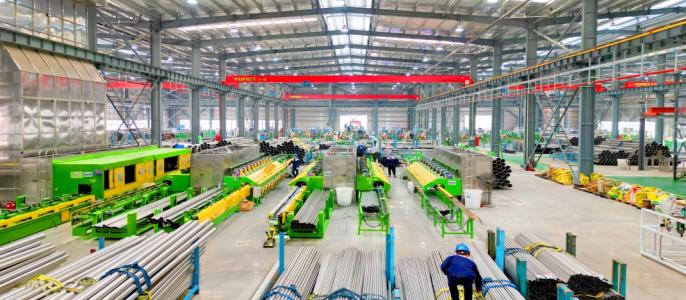
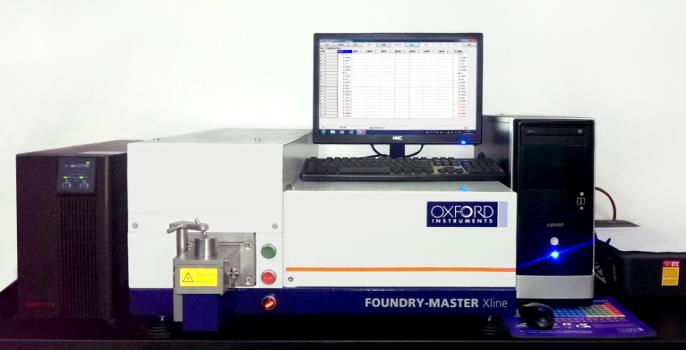
For applications where leakage or batch consistency is a concern, inspection can be planned around the points that usually matter most: incoming material verification, weld appearance, dimensional recheck, air-tightness or sealing test, and traceability records for project batches.
Before production
- Confirm OD, wall thickness, length and end form.
- Confirm stainless grade and copper-end requirements.
- Confirm coolant, refrigerant or fluid service conditions.
During supply
- Factory joining of the stainless body and copper ends.
- Dimension and appearance checks during processing.
- Leak or sealing test before delivery when required.
- Packaging suitable for export shipment.
For your records
- Material certificate according to order scope.
- Inspection or test records when specified in the PO.
- Labeling and packing marks for project traceability.
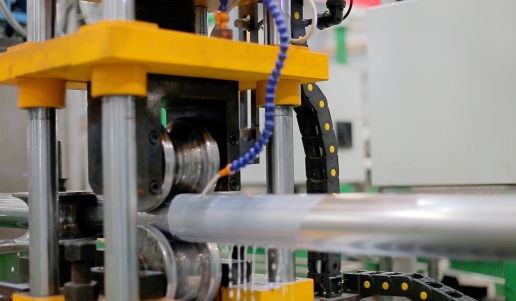
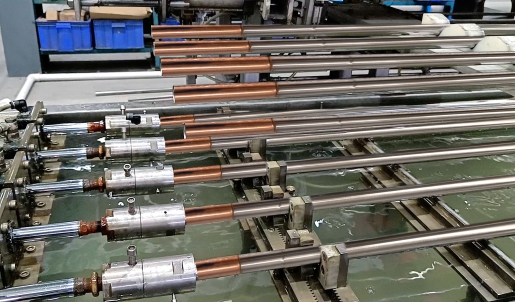
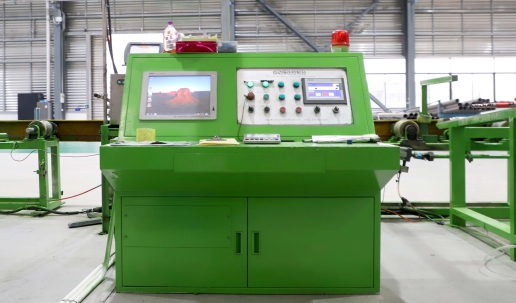
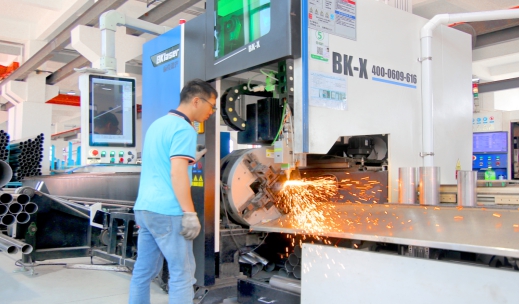
Manufacturing and Testing Details
Frequently Asked Questions
Is a copper-steel connecting tube the same as a copper pipe?
No. It is a stainless steel tube with pre-fabricated copper ends, designed to replace copper piping while letting you braze
copper-to-copper on site—not a plain copper pipe.
How do I connect it to my existing copper system?
You braze copper-to-copper at the tube's copper ends, the same way you already join copper. No field welding of stainless is
required, and the flared end butt-joins straight into existing copper.
Will the copper-to-stainless joint cause galvanic corrosion or leaks?
The dissimilar-metal joint is made and leak-tested under controlled factory conditions rather than in the field, which keeps the
highest-risk connection consistent and traceable. Joint detailing for your service environment is confirmed per project.
Can it handle R410A or refrigerant pressure?
Yes. The tube is supplied to a working pressure rating matched to refrigerant service, including high-pressure refrigerants such
as R410A. The exact rating is confirmed against your system and stated on the material certificate.
Is it compatible with glycol or dielectric coolants?
The stainless body is well suited to liquid-cooling fluids that corrode copper, including glycol-based and dielectric coolants.
Compatibility for your specific coolant and operating conditions is confirmed per project.
What sizes, wall thicknesses and stainless grades are available?
Outer diameters from roughly 15.88 to 54.1 mm, stainless wall thickness 1.0–1.5 mm in the common range, in S30403, S30408
or SUS316. Other sizes are available to specification.
Can it replace copper in data center liquid cooling?
Yes—it works as a stainless transition section that joins into an existing copper interface or coolant loop. It is a
connecting tube, not a complete CDU or cooling skid.
How much can it save versus copper?
Building the main run from stainless lowers your exposure to copper price volatility; actual savings depend on size, run length
and the copper market at the time of order.
Request Specifications and a Quote
To get a useful response, send the working conditions first. Chalco will check the size, end form and material selection before quoting your copper-steel connecting tube. Lead time and MOQ are confirmed per order.
- Application: data center liquid cooling, HVAC & refrigeration, heat pump, VRF, industrial cooling or fluid transfer.
- Size: OD, wall thickness, length, flared-end size and quantity.
- Material: S30403, S30408, SUS316 or project-specified stainless grade.
- Service condition: coolant, refrigerant or fluid type; working pressure and temperature if available.
- Connection requirement: drawing, existing copper interface, insulation sleeve and packaging requirement.